
Daoist comparison
Yin-yang, pause and action: reading a relationship rather than choosing a side
A focused comparison between complementary tendencies in the Dao De Jing and SCW's images of stillness and action, with a clear distinction from the Buddhist Middle Way.
Must strength always look forceful? Must a pause mean giving up? The images of contrasting choices in Uma jornada para si mesmo offer a useful starting question: what relationship are the apparent opposites forming?
This article brings a Daoist text into conversation with SCW art. It does not claim that the video teaches Daoism or that all spiritual traditions share one system.
Start with named passages
Chapter 2 of the Dao De Jing presents paired terms whose meanings arise in relation to one another, including difficult/easy and long/short. Chapter 42 explicitly names yin and yang in a passage about harmony. We consulted Bruce R. Linnell’s 2015 translation alongside its displayed Chinese text. Translation choices matter, so these chapter references are more precise than “Taoism says balance.” Dao De Jing, chapters 2 and 42.
Our application is narrower: a still moment can prepare a response, and a response can create room for another pause. This is an SCW comparison inspired by those passages, not an ancient breathing prescription.
Read a diagram without making it a moral ranking
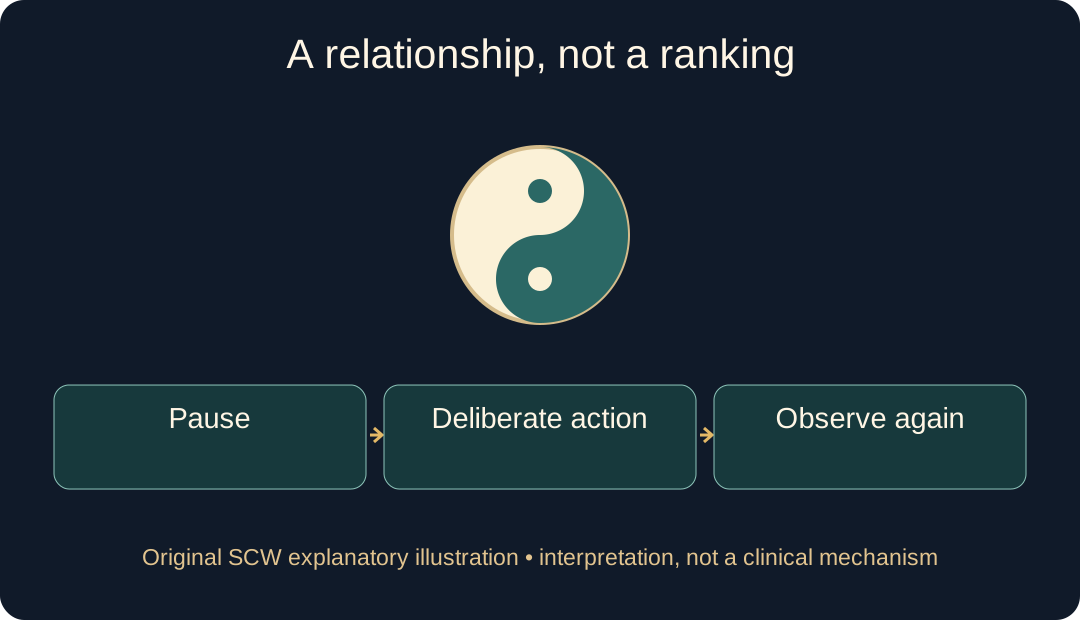
The light and dark areas in our illustration are related parts of one composition. Treating dark as evil and light as good would collapse the question into a moral ranking that the diagram is not intended to teach.
Likewise, this drawing does not assign people fixed “yin” or “yang” identities. It is not a gender test, a personality scale or a map of measured bodily energies. We are using a familiar visual comparison to ask about the relation between receptive attention and purposeful action.
The specific circular drawing is our contemporary explanatory illustration. The cited chapters are textual sources; we are not claiming that this exact diagram accompanies their earliest versions.
Follow one everyday situation
You receive a demanding message. A pause lets you read what was requested. A response states what you can do. A later check shows whether your response was understood.
The visual sequence is notice → choose → act → notice again. Each stage changes what the next stage can use. None guarantees harmony with the other person, and an urgent situation may call for immediate action.
This also clarifies the boundary in the warrior story: yielding the urge to escalate is different from surrendering a necessary limit. That sentence is our interpretation of the scene, not a translated line from Laozi.
“Middle Way” is a separate source question
In the Buddhist discourse SN 56.11, the Middle Way is presented in relation to avoiding sensual indulgence and self-mortification and is identified with the Noble Eightfold Path. That is a specific teaching, not simply the midpoint between any two opinions. SN 56.11, Thanissaro Bhikkhu’s translation.
An SCW title about a “middle path” can be an everyday metaphor. If we discuss the Buddhist teaching, we name and explain that source. If we discuss yin-yang through the Dao De Jing, we name that text. The two can be compared without being presented as identical.
An exercise in reading the artwork
Choose one frame with a contrast: closed/open, still/moving or near/far. Describe both sides, then ask what each makes possible for the other. Draw one arrow for a change you can actually see. Only afterward add a personal reading and a possible action.
That order keeps the illustration connected to the story. It also prevents a familiar symbol from doing all the explaining while the actual scene remains vague.
References and scope
- Lao Zi, Dao De Jing, chapters 2 and 42; Bruce R. Linnell, A Minimalist Translation (2015). Chinese text and translation. Textual source; our application is identified separately.
- SN 56.11, Dhammacakkappavattana Sutta, translated by Thanissaro Bhikkhu. Buddhist primary text in translation, used to distinguish the Middle Way’s context.
Consulted 15 October 2026. No health effect, universal spiritual equivalence or ancient origin for our illustration is claimed.