
Story & reflection
One symbol, one question, one choice
How to explore animal and warrior imagery with clear cultural context, distinguish observation from interpretation, and choose an everyday action.
A shield can protect a boundary. An open hand can make room for another response. In an SCW story, those images invite a question: What am I trying to protect, and how do I want to act?
The answer belongs to the situation. This companion to Uma jornada para si mesmo develops a way of reading symbols without turning them into instructions, diagnoses or universal cultural meanings. It also offers a lens for the opening chapter of The Warrior’s Choice.
Keep four layers visible
The scene: describe what is shown. “A figure holds a shield and opens one hand” is a description. It does not tell us the intentions of a real person.
The source: identify whose interpretation is being discussed. An author’s contemporary spiritual system, a community’s teaching and a newly written fictional story are different kinds of material.
The reading: make the metaphor explicit. Here, the shield can stand for a boundary and the open hand for a possible invitation. That is an SCW editorial reading, not a claim that every culture uses those objects in this way.
The action: choose an ordinary gesture that fits the situation. You might ask for time, decline a request or make one careful offer. The metaphor does not decide for you.
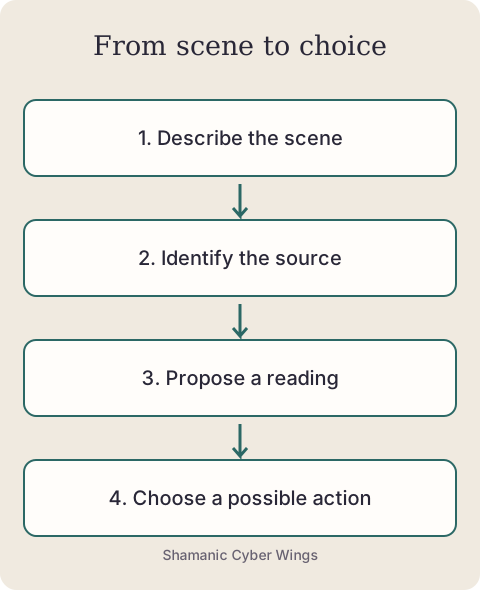
Move from what is visible to a choice you can name. Return to the source whenever a cultural claim is involved.
Animal imagery: observation before meaning
Suppose an owl remains on a branch in an illustrated scene. We can describe that image before adding a meaning. “Observe before responding” is a possible metaphor for this story. It is not proof that an owl predicts an event or carries the same teaching across traditions.
The same method works with a wolf walking beside others or a sea turtle moving through water: first describe the actual scene; then state the reading you are proposing. A fictional animal’s action is not wildlife research, so claims about real behavior need their own zoological source.
This distinction allows power-animal imagery to remain evocative while leaving room for a viewer who understands it differently.
Cultural context changes the question
The Smithsonian National Museum of the American Indian’s Native Knowledge 360° Essential Understandings emphasizes the diversity of Native peoples and the importance of Native perspectives. That framework does not supply a universal dictionary of animal symbols.
Before presenting a meaning as a community’s teaching, identify the community and a source that actually supports the attribution. A broad phrase such as “shamanic wisdom says” is not enough. If we do not have that source, we can still offer an original metaphor and label it as such.
This article does not attribute an animal meaning to Jamie Sams, David Carson, Lakota communities, Pueblo communities or any other tradition. A future article examining a particular work or teaching should cite that specific source and preserve its context.
A word for an emotion is not a guaranteed remedy
It can be useful to distinguish “the message arrived” from “I feel pressure.” Yet naming a feeling should not be advertised as a reliable way to make distress disappear.
In laboratory experiments using aversive pictures, Levy-Gigi and Shamay-Tsoory found that the effects of affect labeling differed by emotional intensity: distress decreased in high-intensity conditions and increased in low-intensity conditions in their second experiment. Those results do not validate an SCW symbol exercise or predict a reader’s response to a difficult conversation. PLOS ONE, 2022.
We use that evidence to keep the promise limited: a reflection question may help you articulate a choice, but its usefulness must remain open to your experience.
A practical example: a boundary without a fight
Imagine receiving another request when your time is already committed.
- Describe: “I have been asked to take on one more task.”
- Identify the tension: “I want to be helpful, and I need to protect the time already promised.”
- Choose a reading: the shield represents the commitment you need to protect; the open hand represents a specific alternative, if you wish to offer one.
- Make it concrete: “I cannot take this on today. I can help you identify the first step tomorrow.”
An offer is optional. A clear “no” may be the appropriate boundary. You do not need to remain in an unsafe situation or keep negotiating to demonstrate inner peace.
The middle path does not require splitting every difference
In this article, “middle path” is an everyday question about competing needs, not a presentation of a Buddhist doctrine. Some choices allow adjustment; others require a firm limit. Ask what needs protection, what is negotiable and what information is missing.
End with three lines: what happened, what I can choose, and one next action. If a symbol adds clarity, keep it. If it distracts from the situation, leave it aside. For an optional pause before writing, see A pause before interpreting.
Choose one interpretive lens
The broader method above can lead to a narrower article: the warrior and a Jungian shadow question, yin-yang and related contrasts, an owl in a contemporary power-animal reading, or Raven in Bill Reid’s Haida art. Each names its own sources and context. Comparing them does not make them one spiritual system.
Sources and scope
- National Museum of the American Indian. Native Knowledge 360°: Essential Understandings. Cultural education framework developed with Native communities; supports specificity and context, not our invented symbol meanings.
- Levy-Gigi, E., and Shamay-Tsoory, S. (2022). Affect labeling: The role of timing and intensity. PLOS ONE, 17(12), e0279303. Primary research. Laboratory task; no test of these stories or exercises.
Sources checked on 15 October 2026. The four-layer method, diagram, metaphors and scenario are original SCW editorial interpretations. They are not clinical tools or representations of a named ceremony.